
Auto-fix is in beta. Paid plans and trials include an allowance of auto-fix pull
requests. See Limits.
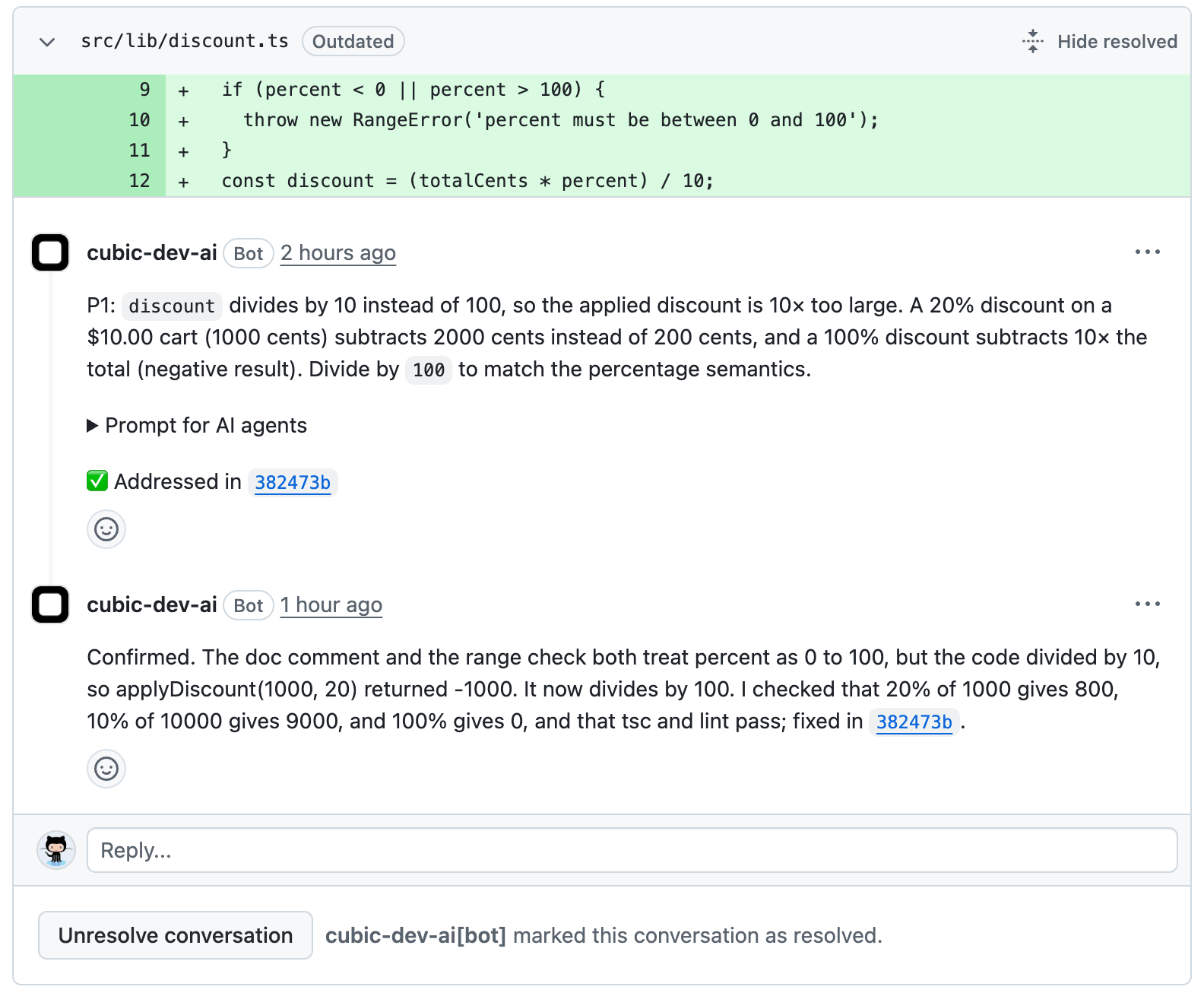
How it works
When cubic finishes reviewing your pull request, auto-fix:- Checks each issue - Reads the code to see if the issue is real
- Fixes the real ones - Makes the change and runs your lint, type-check, and tests where it can
- Pushes the fix - Commits to your PR branch
- Replies on each thread - Explains what it decided and resolves the thread when it’s done
cubic.yaml sets reviews.incremental_commits: false.
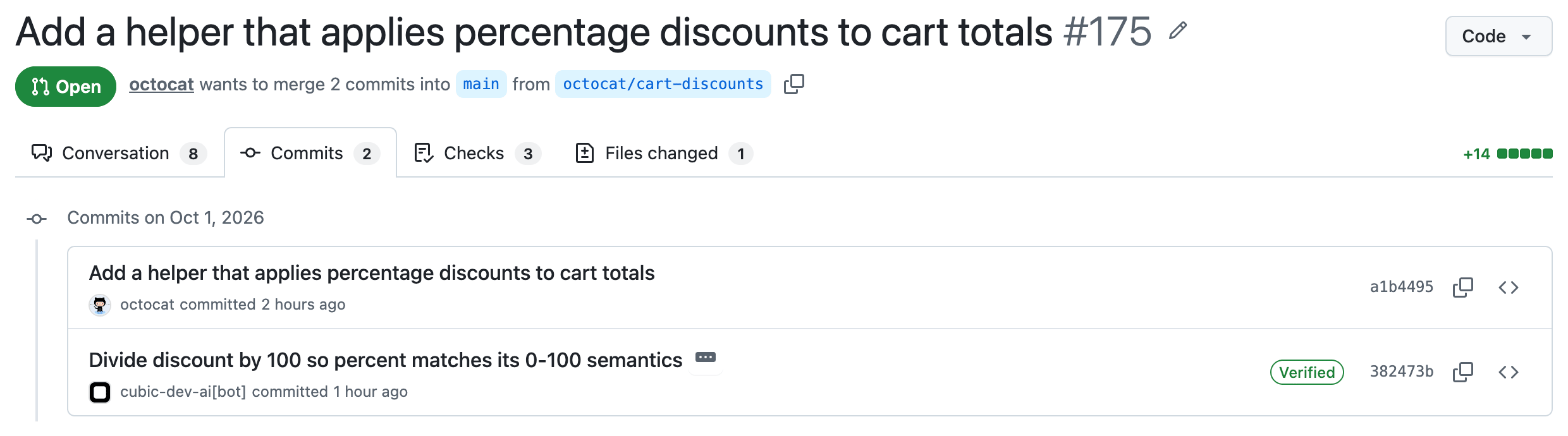
What cubic replies
Each reply starts with cubic’s decision:
Want a say before it runs? Reply on the thread. If you have write access, cubic follows your reply. For example, “leave it” means cubic won’t change the code.
Turn on auto-fix for a pull request
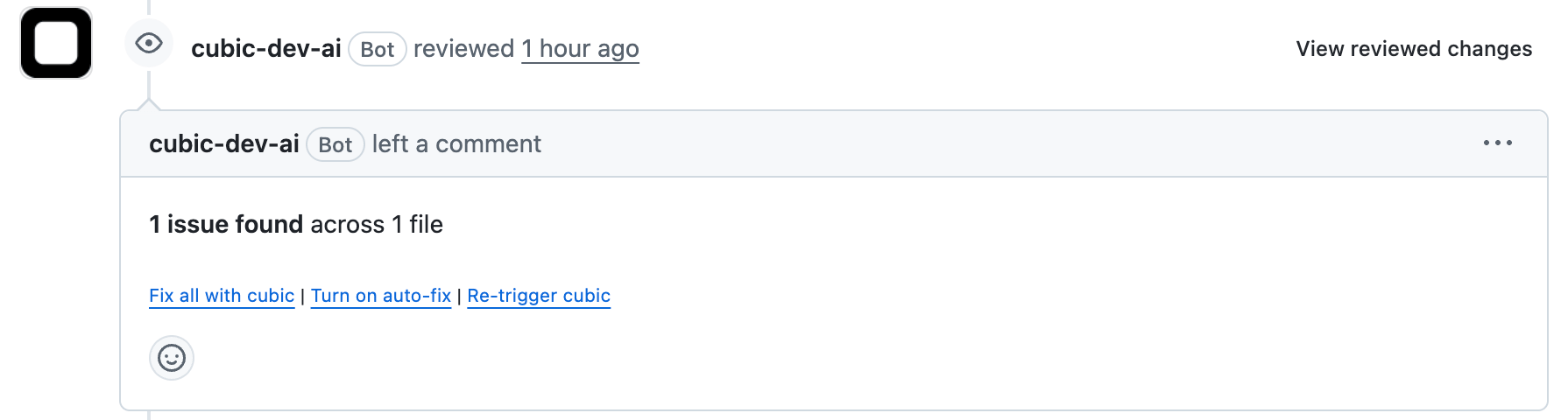
Anyone with write access to the repository can turn auto-fix on or off from:- GitHub - Click Turn on auto-fix in the footer of cubic’s review
- PR description - Click the Auto-fix switch next to View guided diff
- cubic - Use the Auto-fix switch on the PR page
- Slack - Click Enable auto-fix on cubic’s review message
- MCP - Ask your coding agent to call
set_pr_auto_fixon the cubic MCP server
Turn on auto-fix for a repository
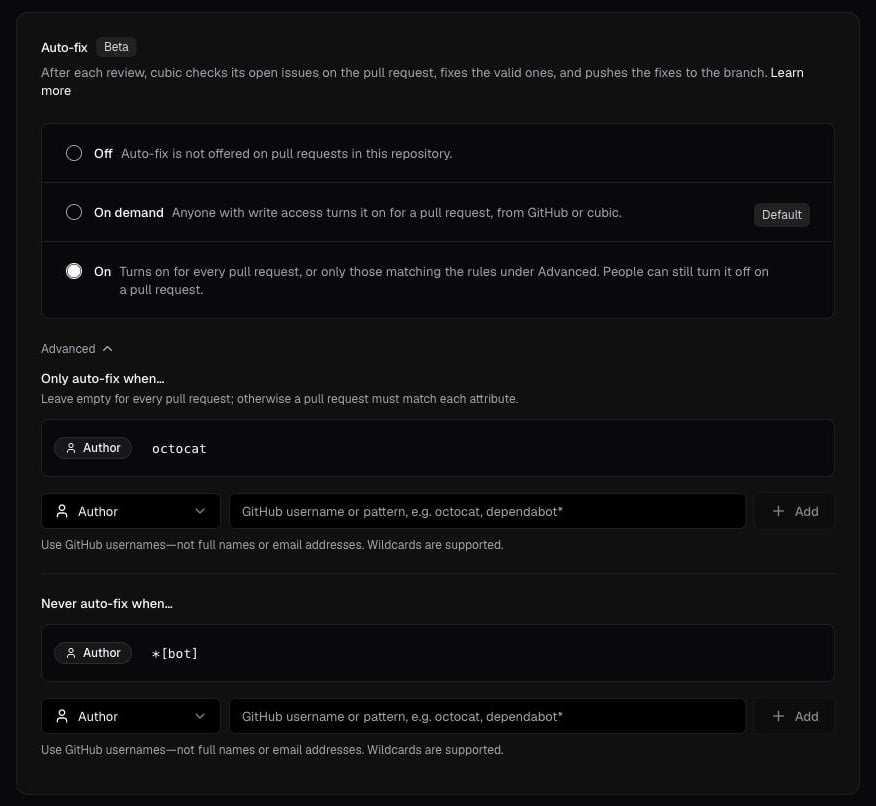
Admins and members can set auto-fix for a repository in AI review → Fixes:- Off - Auto-fix isn’t available
- On demand (default) - Someone turns it on for each pull request
- On - Auto-fix turns on for every pull request that matches your rules. People can still turn it off on a pull request
Rules
When auto-fix is On, rules under Advanced pick which pull requests get auto-fix:- Only auto-fix when… - A pull request must match each of these. For example, an Author rule with your GitHub username runs auto-fix on your pull requests only
- Never auto-fix when… - Any match skips the pull request. For example, skip
*[bot]authors or PRs with ano-auto-fixlabel
issues. auto_fix_rules takes the same PR keys as auto_approve_rules: only_ or exclude_ followed by authors, labels, titles, head_branches, or base_branches.
cubic.yaml has a whitespace-only list item, a value longer than 256 characters after trimming, or an empty only_ list, cubic ignores all the rules and keeps auto-fix On demand until you fix them, or Off if the file sets auto_fix: off. An empty-string item (such as "") invalidates the entire YAML file and falls back to UI settings, which may still have auto-fix On.
Follow a run
Each run opens as a fix session in Fixes. You can watch the agent work and see what it fixed. You can’t send it messages.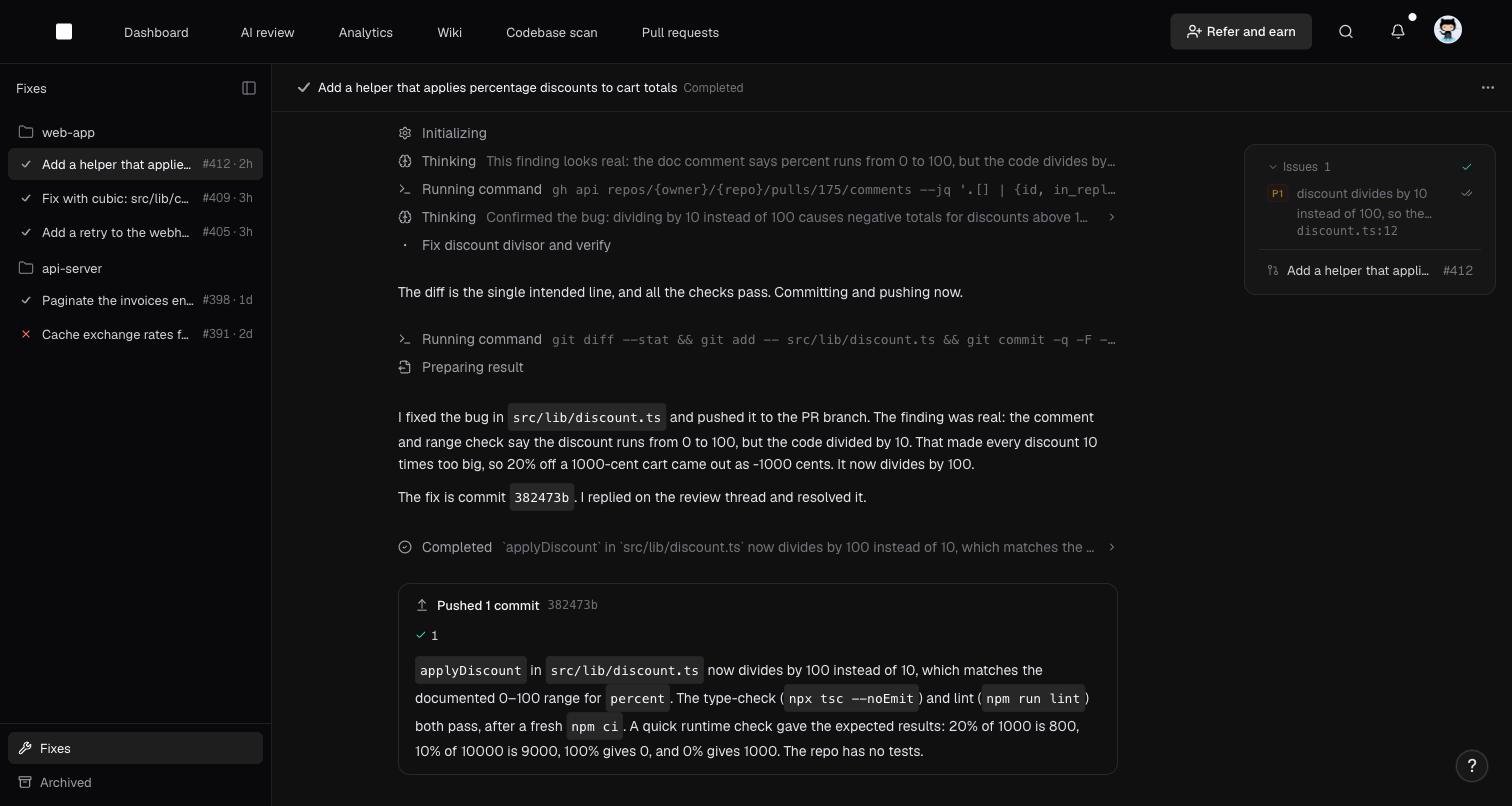
- The cubic · Auto-fix check on the pull request
- cubic’s comment on the pull request
- The cubic PR page
Stop auto-fix
- Turn it off - From any place you can turn it on. A run in progress finishes first
- Push your own commits - cubic stops the current run and picks up again after the next review
- Close or merge the pull request - Auto-fix turns off, and the pull request’s fix sessions move to Archived
Limits
Each organization can auto-fix a set number of pull requests per billing period, shared across its repositories:
Paid plans reset monthly, including annual subscriptions. The trial allowance covers the whole trial and resets when it ends.
A pull request counts once per period, the first time auto-fix starts a run on it. Later runs, retries, and pushes on that pull request don’t count again. Each pull request gets up to 10 auto-fix runs per period.
When your organization reaches its limit, auto-fix pauses on new pull requests until the period resets. Pull requests that already count keep running. The PR page shows why auto-fix paused and when it resumes. See your usage in Settings → Usage.
Tell cubic how to fix
cubic reads your repository’sAGENTS.md. Keep general guidance for coding agents there.
For guidance just for cubic’s fixes, like which issues are worth fixing in your codebase, add coding agent instructions.
Troubleshooting
Not seeing Turn on auto-fix?
Not seeing Turn on auto-fix?
- In AI review → Fixes, make sure the Fix with cubic button is on, the coding agent provider is Default (cubic), and auto-fix isn’t Off
- Make sure you have write access to the repository
- Pull requests from forks aren’t supported, because cubic can’t push to them
Auto-fix didn't turn on by itself?
Auto-fix didn't turn on by itself?
- Check that the repository is set to On and the pull request matches your rules
- If someone turned auto-fix off on the pull request, it stays off there. Turn it back on from the pull request
- With label rules, auto-fix turns on after the first review, not when the PR opens
Auto-fix paused?
Auto-fix paused?
- Your organization used its auto-fix pull requests for the period, or the pull request used all its runs for the period. See Limits
- After the reset date shown on the PR page, auto-fix resumes at cubic’s next review. To resume right away, click retry next to paused on the PR page
Auto-fix stopped?
Auto-fix stopped?
- After three failed runs in a row, auto-fix stops. Click Retry fix in the fix session or push a commit
- If you pushed commits, auto-fix picks up again after cubic reviews them
Want cubic to change a decision?
Want cubic to change a decision?
- Auto-fix doesn’t revisit an issue it already decided, but you can still ask for a fix. Comment
@cubic fix thison the thread, and cubic starts a separate fix - For Needs your input., tag cubic with your answer, for example
@cubic keep three retries and fix this